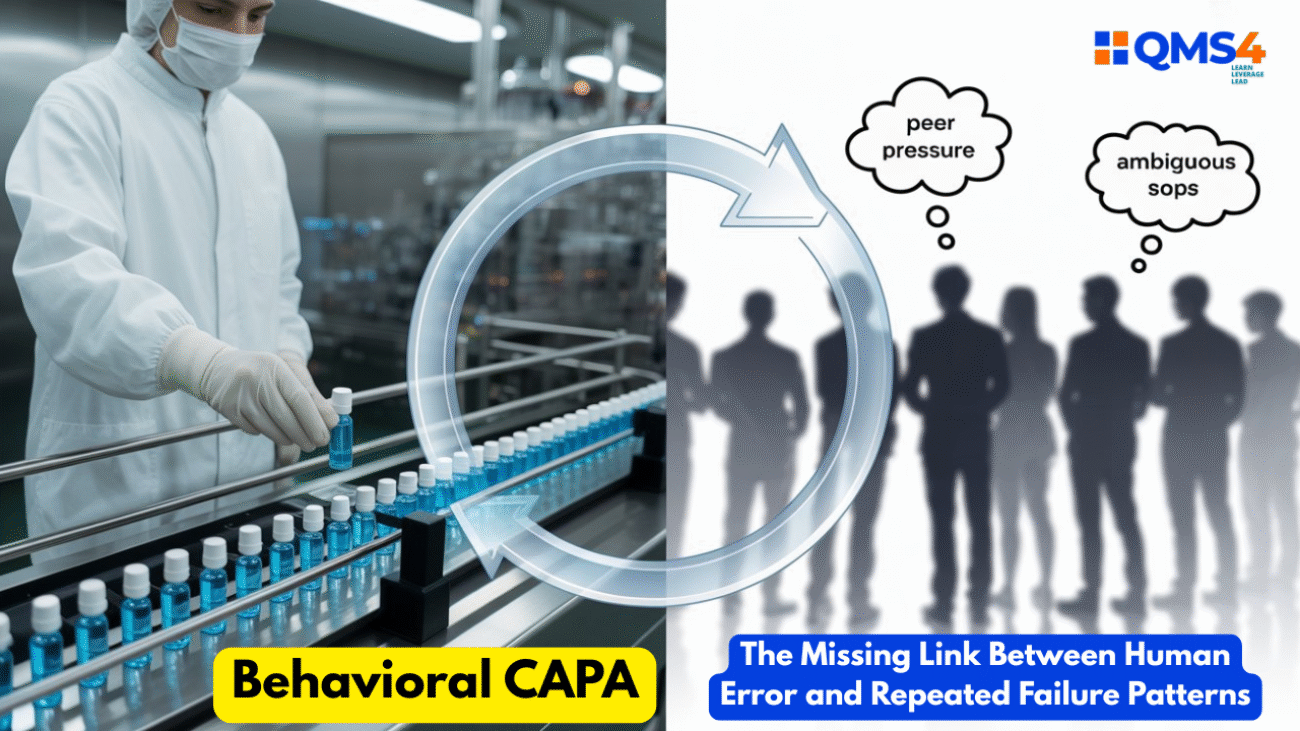
Split-screen photo of a pharmaceutical operator making a sequence error on the production line and shadowy figures with thought bubbles showing behavioral challenges like peer pressure and unclear SOPs.

Behavioral CAPA: The Missing Link Between Human Error and Repeated Failure Patterns

A Familiar Story in Quality

The deviation was raised at 6:14 PM.

A filling line operator had added a component in the wrong sequence—again. This wasn’t the first time it had happened on that line. Still, the supervisor followed protocol:

  • Deviation logged

  • Investigation opened

  • Root cause marked as “human error”

  • CAPA assigned: Retrain the operator

  • Batch released

A month later, the same deviation occurred—different operator, same mistake.

And once again, the cycle repeated.

This story isn’t from one facility—it echoes across hundreds. In pharma and life science plants worldwide, GMP compliance is chased like a moving target. But here’s the deeper issue: it’s not just the procedures—it’s the patterns. And those patterns begin with people.


The Standard CAPA Cycle: A System Designed to Move On, Not Dig In

Most CAPA systems follow a familiar structure:

  1. Identify the issue (Deviation, Audit finding, Complaint, etc.)

  2. Investigate and determine the root cause

  3. Implement corrective and preventive actions

  4. Close the record

This approach is clean, auditable, and efficient. However, there’s a fundamental flaw.

This cycle is built for resolution, not transformation.

For example, in many facilities:

  • Root cause = Operator forgot or didn’t follow the SOP

  • Corrective action = Retrain the operator

  • Preventive action = Update the SOP or add a checklist

But what happens when:

  • The same operator repeats the mistake?

  • Another operator makes the same error?

  • The checklist is ignored under time pressure?

In those cases, the CAPA might close—but the risk quietly reopens.


Human Error: Convenient Label, Dangerous Assumption

When a deviation is marked as “human error,” it often signals three things:

  • A fast way to move the record forward

  • A protective shield for the system

  • A convenient label that ends the conversation

But human error is not a root cause. It’s just the beginning.

Instead of asking, “Who did it?”, we should ask:
“Why did it make sense to do it that way?”


Introducing Behavioral CAPA: A Missing Link in Quality Systems

Behavioral CAPA doesn’t ignore human error. It investigates it.

It asks:

  • What behavioral patterns or team dynamics contributed to the event?

  • What cognitive biases were at play?

  • How did context shape decisions?

It examines:

  • Pressures and incentives

  • Organizational norms

  • The gap between formal policy and real-world behavior

Rather than assigning blame, it fuels curiosity. Instead of closing the file, it opens a mirror.


Case Example: The Unwritten Rule That Broke the SOP

At a sterile manufacturing site, an SOP required double verification before component addition. Yet staff skipped it—then logged it as complete.

The formal investigation listed “non-compliance”. But behavioral analysis revealed deeper truths:

  • Unrealistic production targets

  • Subtle supervisor pressure to “keep the line moving”

  • Peer normalization of shortcuts:
    “We all do it—just don’t get caught.”

The CAPA? Retraining.

The real outcome? No change. Same issue returned next quarter.

What could Behavioral CAPA have done differently?

  • Assessed pressure from production KPIs

  • Redefined metrics to value quality, not just speed

  • Delivered team-based behavioral training

  • Fostered psychological safety to report unsafe norms


Why Patterns Repeat: Because We Fix Events, Not Systems

Quality systems are built around events:

  • One deviation

  • One complaint

  • One audit finding

But human behavior doesn’t work like that. It runs in patterns:

  • People shortcut when under pressure

  • Silence becomes survival when mistakes lead to punishment

  • Workarounds spread faster than policy updates

Traditional CAPA addresses the event. Behavioral CAPA addresses the environment that makes those events likely.


The Data Lie: Trends Don’t Show Truth Without Behavior

Your audit slide might proudly show:

  • ✅ CAPAs closed in 30 days

  • ✅ Recurrence rate reduced

  • ✅ 100% training completion

But what if:

  • Staff rush through LMS modules without learning?

  • SOPs are signed under time pressure—without reading?

  • Investigations are templated and fear-driven?

These metrics provide a false sense of control.

Behavioral CAPA pushes deeper—beyond the numbers, into the behaviors they hide.


Behavioral Root Cause Categories: A Smarter Lens

Behavioral CAPA enhances—not replaces—your tools by layering in behavioral root causes:

Category Example Behavior
Time Pressure Rushing checks during changeover
Group Norms Following peers who bypass steps
Fear Culture Hiding errors to avoid blame
Ambiguous SOPs Interpreting unclear instructions
Learned Helplessness “Reporting won’t change anything”
Overreliance on Memory Forgetting steps in complex tasks
Poor Feedback Loops Not hearing what happened post-deviation

These categories unlock the “why” behind the repeated “what.”
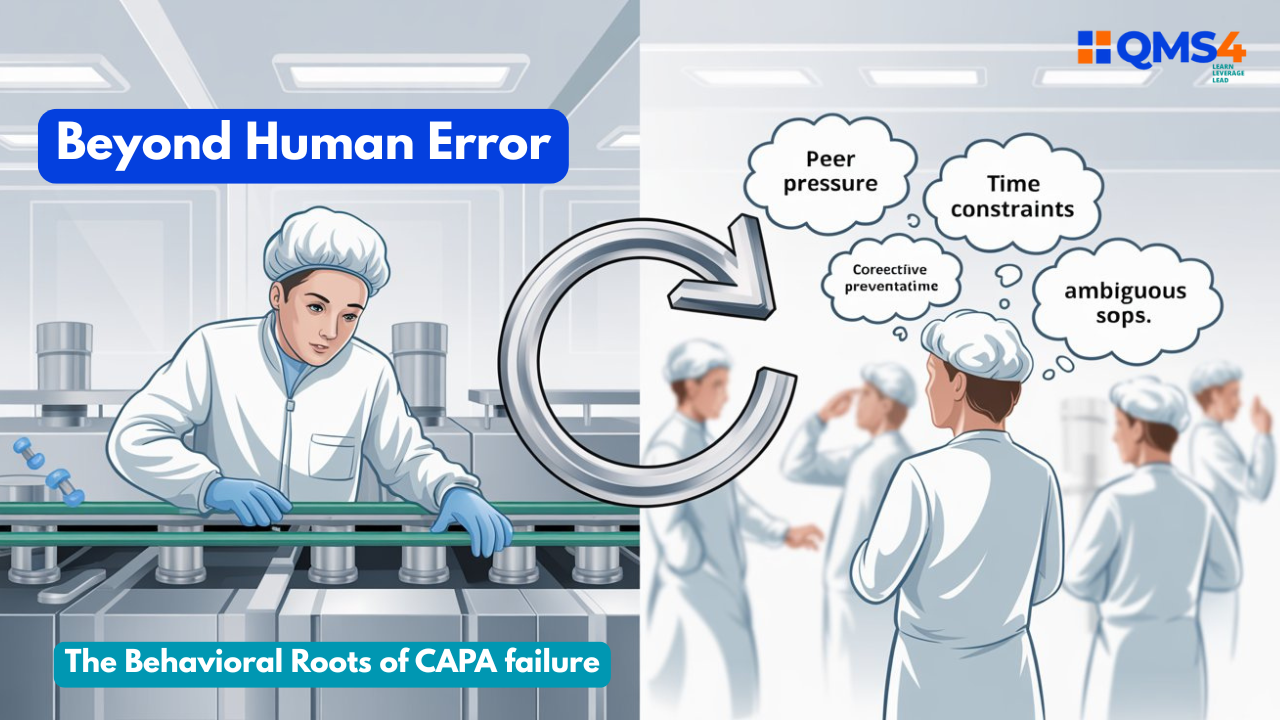
Operator placing component with fear; visual shows peer pressure and unclear SOPs as root behavioral causes of CAPA failure.
Behavioral oversights—like peer pressure, poor SOPs, and fear—often derail CAPA before it starts.

Integrating Behavioral CAPA into Your QMS

Here’s how to get started:

1. Upgrade RCA Templates

Add behavioral prompts:

  • What made this behavior seem acceptable?

  • Was there peer pressure or incentive misalignment?

  • How common is this behavior—even when not reported?

2. Train Investigators in Behavioral Science

Equip QA teams and supervisors with skills to probe:

  • Context

  • Biases

  • Cultural norms

3. Map Behavior Loops

Use tools like:

  • Behavior mapping

  • Cause-and-effect charts with human factors

  • Peer interviews

4. Shift From Fixing to Rebuilding

Design CAPAs that:

  • Change the environment

  • Adjust expectations

  • Rewire feedback and communication
    Not just tweak policies.


Behavioral CAPA in Action: A Pharma Case Study

Company: Mid-size injectable manufacturer in Southeast Asia
Problem: Repeated cleaning deviations (“missed spots,” “residue”)
Standard CAPA: Retraining + checklist updates

Behavioral CAPA Revealed:

  • Staff were trained—but rushed due to poor handovers

  • Supervisors discouraged reporting small misses

  • Employees feared blame for admitting mistakes

True Root Cause:

Fear culture + shift pressure

CAPA Redesign:

  • Introduced 5-minute shift buffers

  • Created open forums for mistake-sharing

  • Changed KPIs: from “cleaning time” to “cleaning quality”

Result:
🔻 70% drop in cleaning-related deviations over 6 months
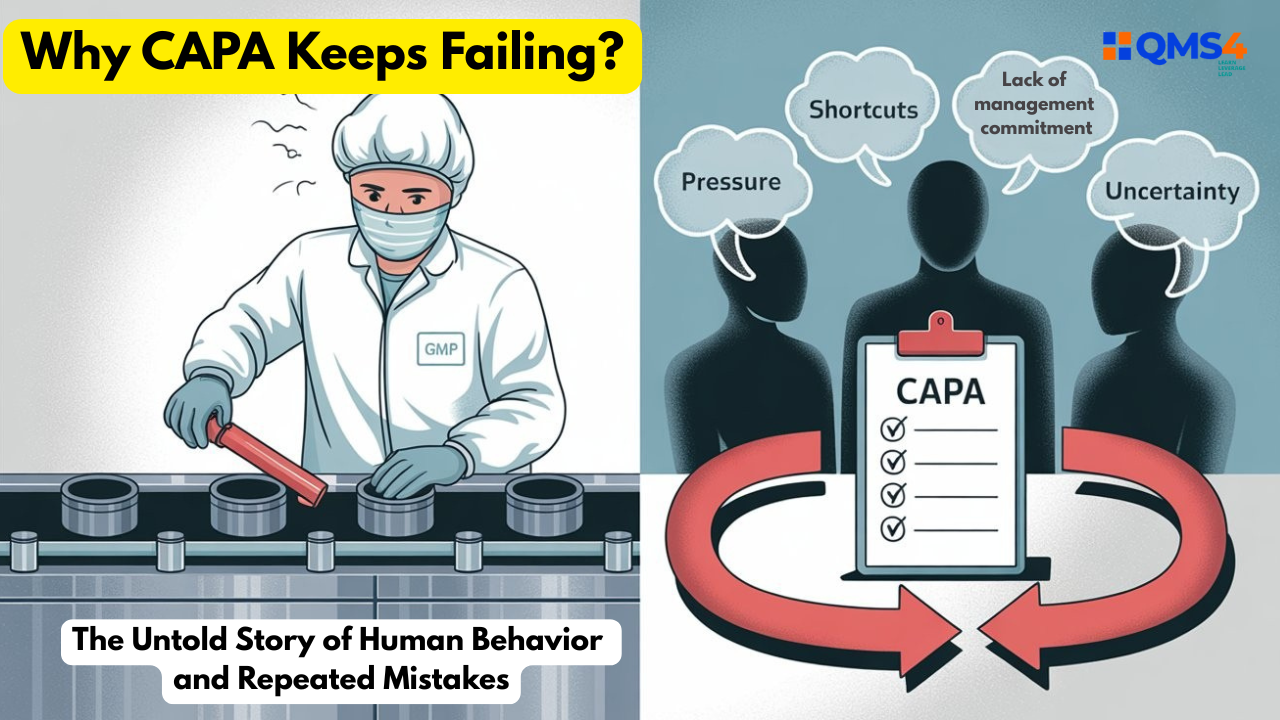
Visual representation of behavioral factors causing failures in CAPA processes within pharmaceutical quality management.
The behavioral roots behind why many CAPA initiatives fail in pharma quality systems.

Why This Matters: Behavioral CAPA Isn’t Just a Fix—It’s the Future

The industry is shifting:

  • Regulators now care about culture, not just checklists

  • Patients demand trust—not just timelines

  • Digital QMS systems automate workflows—but not wisdom

Behavioral CAPA isn’t optional. It’s essential.

It creates systems that understand people—not just procedures.


Reflective Takeaway

Next time you list “human error” in a deviation, pause.

Ask yourself:

  • What system allowed that behavior?

  • What pattern am I ignoring?

  • Will this fix break the cycle—or just delay the next incident?

Behavioral CAPA is not about assigning blame.

It’s about creating a system where the truth feels safe—and change feels possible.


Conclusion

Despite best intentions, many CAPA investigations fail because they stop at the surface. They treat symptoms, not causes. While procedural fixes may check audit boxes, the same deviations resurface—sometimes in new disguises. Why? Because behavior, culture, and mindset are rarely part of the root cause conversation.

Until we look beyond the incident—into why people act the way they do—we’ll keep cycling through CAPA loops that change nothing.
It’s time we stop blaming “human error” and start understanding it.

💬 What hidden behaviors have you seen quietly sabotage quality systems—yet never make it into the report?
👇 Share your story or insights in the comments—let’s break the silence around the real roots of CAPA failure—together.

Want more insights like this?

Connect with Lokman | Subscribe to my Weekly Newsletter (Quality Career and GMP Insights) | Follow QMS4 | Visit: www.qms4.com 
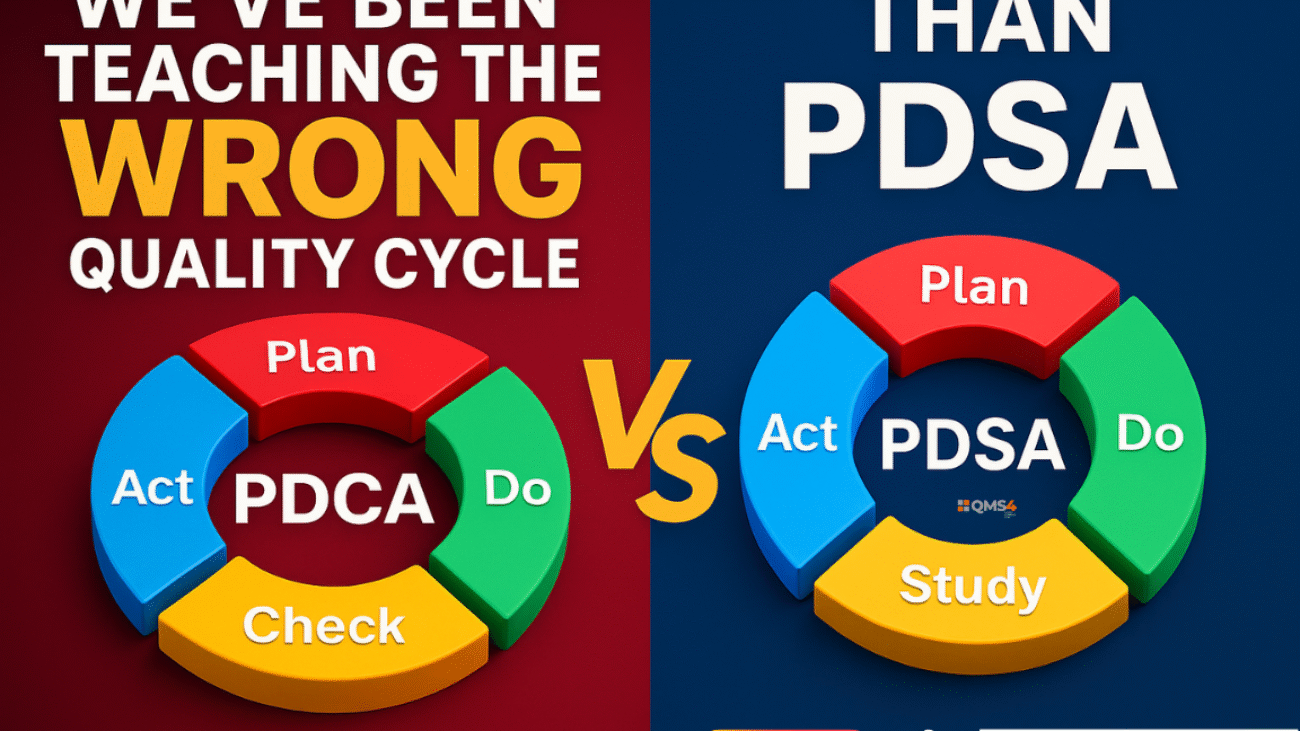
Comparison of PDCA vs PDSA cycles showing why PDCA became more popular than Deming’s PDSA method

PDCA vs PDSA: Why PDCA Became Famous Even Though Deming Prioritized PDSA

Most quality professionals are introduced to the concept of continuous improvement through a familiar four-letter cycle: PDCA—Plan, Do, Check, Act.
It appears in ISO standards, Lean handbooks, training courses, SOPs, and improvement posters in factories around the world.

Yet a surprising contradiction sits behind this global adoption:

W. Edwards Deming, whose teachings heavily influenced modern quality management, did not endorse PDCA.
Deming consistently promoted PDSA—Plan, Do, Study, Act, a version that emphasizes learning, analysis, and systemic understanding rather than inspection.

So how did the world end up championing a model that the original architect himself rejected?

To answer this, we need to look at the history, the culture of early industrial quality systems, and the behavioral implications of “Check” versus “Study.”
This article explores the origins, the divergence, and the impact of using PDCA instead of PDSA in modern quality systems.


1. The Origins: PDSA Started Before PDCA

The first known version of this cycle originated not with Deming, but with Walter A. Shewhart, Deming’s mentor.
Shewhart proposed the concept as a scientific process of iterative learning:

  • Specify the problem

  • Try a solution

  • Observe what happens

  • Reflect and adapt

Deming expanded Shewhart’s ideas into a structured cycle—Plan, Do, Study, Act—emphasizing:

  • experimentation

  • learning from variation

  • continual refinement

  • system-level understanding

“Study” was the heart of the model because Deming believed:

“Without study, there is no true improvement—only activity.”

His intention was clear: improvement requires more than checking compliance or pass/fail outcomes.
It requires understanding why the system behaves as it does. Here is the original article link – click here


2. How PDCA Became Popular in Japan — Without Deming’s Approval

During the 1950s, Deming worked extensively with Japanese industry through JUSE (Japanese Union of Scientists and Engineers).
Japanese manufacturers wanted a model that factory workers could quickly understand and apply on the shop floor.
They also needed a model that aligned with the cultural and operational realities of post-war production.

This is where the shift began.

JUSE adapted Deming’s PDSA cycle—not out of disagreement, but out of practicality.
In Japanese manufacturing culture at the time, inspection was the dominant understanding of quality.

So instead of “Study,” JUSE adopted the more familiar term “Check.”

This gave birth to the PDCA cycle:

  • Plan

  • Do

  • Check

  • Act

It was simple, familiar, and aligned with the Japanese focus on process verification.
But the adaptation carried a hidden cost:
It shifted the mindset from learning to inspection.

Deming repeatedly clarified that he did not endorse PDCA.
He felt “Check” implied passive evaluation rather than active learning.

In his later lectures, Deming stated:

“The ‘Check’ step does not encompass the idea of learning from data.
Study is the correct word.”

Despite this, PDCA had already gained remarkable traction in Japan.


3. Why PDCA Spread Globally While PDSA Didn’t

Once Japanese industry adopted PDCA, the model gained momentum—much faster and wider than PDSA ever had.
There are several key reasons for this:


3.1 PDCA Was Simpler and Easier to Teach

Trainers, consultants, and educators found PDCA:

  • easier to explain

  • easier to visualize

  • more intuitive for frontline workers

  • easier to scale across teams and sites

“Check” felt logical.
Everyone checks work.
Everyone checks results.
Everyone checks compliance.

By the time Deming clarified his preference for PDSA, the world had already standardized PDCA in training materials, textbooks, and ISO documentation.


3.2 PDCA Fit the “Inspection-Based” Quality Culture of the Era

Early industrial quality was heavily focused on:

  • post-production checks

  • conformance

  • pass/fail criteria

  • inspection points

  • defect detection

PDCA aligned naturally with that culture.
“Check” reinforced existing behavior.

By contrast, “Study” required:

  • analyzing variation

  • interpreting data

  • understanding cause-and-effect

  • reflecting on system behavior

These were more advanced capabilities that many organizations weren’t ready for.


3.3 ISO and Western Quality Systems Codified PDCA

When the global quality movement expanded during the 1980s and 1990s:

  • ISO 9001 adopted PDCA

  • Lean and early TQM programs adopted PDCA

  • Corporate training programs built PDCA into their materials

PDCA became an industry norm before PDSA could gain meaningful traction.
Once embedded into standards and certifications, it became extremely difficult to replace.


3.4 The Language Barrier Played a Role

The word “Study” in English conveys analysis and reflection.
But in many languages, “study” translates to formal education or academic activity.

“Check” was easier to translate and understand in operational contexts worldwide.

This linguistic simplicity helped PDCA scale exponentially.


4. Why Deming Strongly Preferred PDSA Over PDCA

Deming’s concerns with PDCA were not superficial.
His preference for PDSA was grounded in deep principles of:

  • systems thinking

  • statistical reasoning

  • behavioral science

  • learning and adaptation

The difference between “Check” and “Study” may seem small, but the mental models they create are profoundly different.


4.1 “Check” Reinforces an Inspection Mindset

When teams think in terms of “Check,” they tend to:

  • focus on compliance rather than learning

  • look for pass/fail results

  • treat data as static

  • evaluate outcomes rather than causes

  • default to surface-level conclusions

In many GMP and ISO environments, this shows up as:

  • checking whether CAPA was implemented

  • checking whether SOPs are followed

  • checking audit findings

  • checking training completion

This often leads to a procedural approach to quality—not an analytical one.


4.2 “Study” Promotes Learning and Understanding

“Study” forces teams to ask deeper questions:

  • What patterns appear in the data?

  • What variation is normal, and what is special?

  • What does this tell us about the system?

  • What behaviors influenced the outcome?

  • What assumptions were proven wrong?

This aligns with root cause analysis, statistical thinking, and continuous improvement.

For example:

  • studying why deviations occur

  • studying how work-as-done differs from work-as-imagined

  • studying human factors and behavior

  • studying systemic constraints

  • studying patterns over time rather than events in isolation

PDSA encourages organizations to understand the story behind the data, not just check the data itself.


4.3 PDSA Is More Compatible With Modern Quality Systems

Today, the most advanced quality methods are built around learning:

  • Lean A3 thinking

  • Six Sigma DMAIC

  • FDA’s Quality by Design

  • Human and organizational performance (HOP)

  • Risk-based thinking

  • Behavioral quality

  • Modern CAPA effectiveness principles

Each of these approaches requires thoughtful inquiry, not simple evaluation.

In fact, PDSA aligns almost perfectly with modern frameworks:

  • “Plan” = Define the system or problem

  • “Do” = Pilot the change

  • “Study” = Analyze impact and variation

  • “Act” = Standardize or adapt

This makes PDSA a more robust model for regulated industries like pharma, biotech, and food manufacturing.


5. Practical Impact: PDCA vs PDSA in Real Quality Systems

The choice between PDCA and PDSA is not merely academic.
It has practical consequences on how organizations handle:

  • deviations

  • investigations

  • CAPA

  • change control

  • process improvement

  • audit findings

  • risk management

PDCA often leads to:

  • superficial checks

  • limited analysis

  • confirmation bias

  • implementation-focused CAPA

  • lack of behavioral insight

  • repeated deviations

PDSA leads to:

  • deeper data-driven learning

  • identifying systemic and behavioral root causes

  • more effective CAPA

  • stronger preventive measures

  • long-term stability

This mirrors the shift in modern GMP expectations—from “prove compliance” to “demonstrate understanding.”


6. So Should We Stop Using PDCA Entirely?

Not necessarily.

PDCA is:

  • simple

  • easy to train

  • effective for basic improvement cycles

  • useful at the operator or team level

  • helpful for visual management and daily management

But for higher-level problem solving—especially in regulated or complex environments—PDCA falls short.

That’s why many organizations use PDCA for daily improvement and PDSA for analytical or strategic improvement.

A blended approach can work, as long as teams understand the philosophical difference.


7. Final Thought: A Small Word, A Big Mindset Shift

In quality management, terminology often seems minor.
But the shift from Check → Study represents a fundamental change in thinking.

Check asks: “Did we do it?”
Study asks: “What did we learn?”

Behind that difference lies the reason Deming spent decades correcting the world’s understanding of the cycle.

PDCA made quality easy to teach.
PDSA makes quality meaningful to practice.

Want more insights like this?

Connect with Lokman in LinkedIn| Subscribe to my Weekly Newsletter (Quality Career and GMP Insights) | Follow QMS4 | Visit: www.qms4.com 
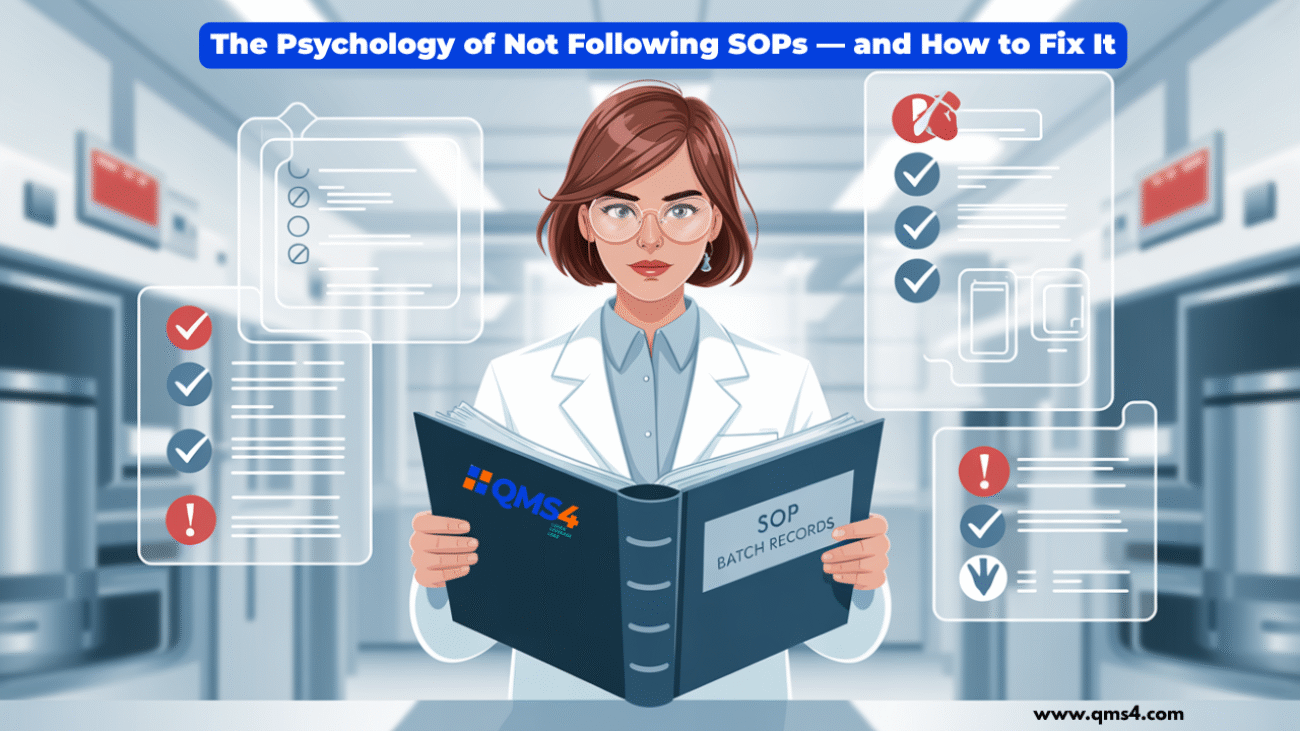
Pharmaceutical worker hesitating to follow SOP in GMP manufacturing environment

The Psychology of Not Following SOPs — and How to Fix It

The audit room was tense and with pile up of SOPs. A stack of batch records sat between the QA lead and the auditor, and everyone knew there was a problem in one of them. Not a catastrophic failure — but a small deviation in SOP that had never been reported.

If you’ve been in GMP long enough, you’ve seen this story before. Someone skips a step of SOP, follows “how we usually do it” instead of what’s written in the SOP, or makes a “temporary” change without approval. Later, during an inspection, that “small thing” becomes the opening line of a 483 observation or an inspection finding.

Why does this happen in environments where compliance is drilled into us? And more importantly, how do we fix it — without burning out our teams or making SOPs into binders nobody reads?

In this article, we’ll explore the psychology of why SOPs aren’t always followed, the human factors behind it, and practical ways to rebuild SOP ownership across your teams.


Why SOP Exist — And Why People Still Skip Steps

We all know the textbook reason: SOPs ensure consistency, compliance, and safety. But in practice? Many employees view them as bureaucratic paperwork that slows them down.

I once walked into a cleanroom where a new operator had been trained on the correct gowning procedure.
Yet, during the shift, they skipped the second pair of gloves.
Why? “It’s faster this way — and everyone does it like this when no one’s watching.”

This isn’t about laziness.
It’s about perception.
If the operator’s daily reality tells them speed is valued over strict compliance, they’ll unconsciously align their behavior with what the culture rewards.

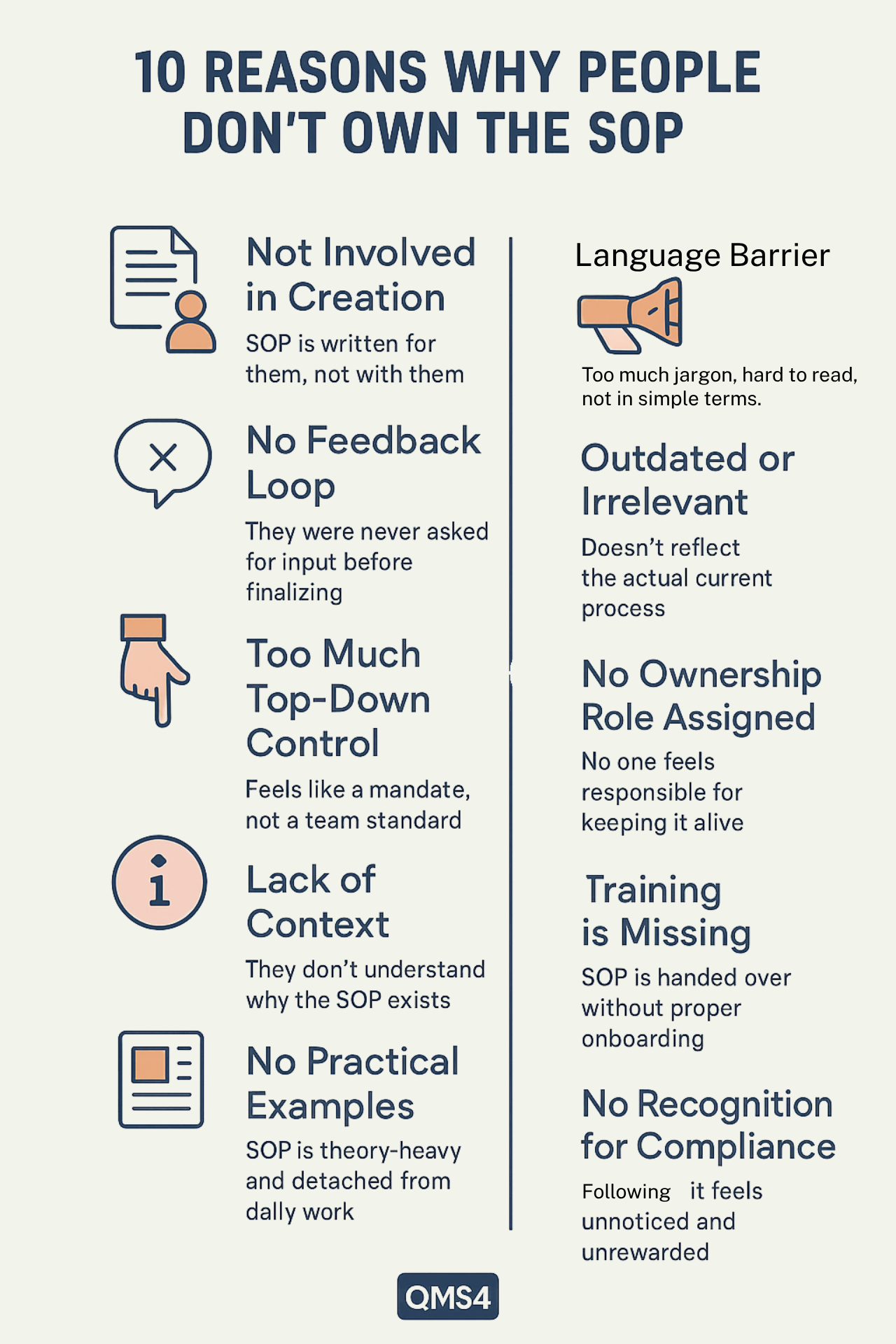
Here are the 10 Reasons Why People Don’t Own SOPs.You can also explore my in-depth LinkedIn newsletter on this topic for more real-world GMP insights.

Top 10 reasons why employees in GMP environments don’t take ownership of SOPs.
Ten (10) key psychological and operational barriers to SOP ownership.

The Early Warning Signs You’re Slipping Into SOPs Non-Compliance

Non-compliance doesn’t start with a critical deviation.
It begins with small behaviors that quietly erode GMP discipline.

You might notice:

  • Operators writing from memory instead of following instructions step-by-step.

  • Minor undocumented changes to process timing.

  • Batch record entries made “later” instead of in real time.

  • Workarounds for inconvenient controls.

Each one seems harmless until you zoom out.
What’s dangerous is not the act itself, but the normalization of deviation.

The worst part? By the time these habits surface in an audit, the behaviors are already deeply embedded in the culture.

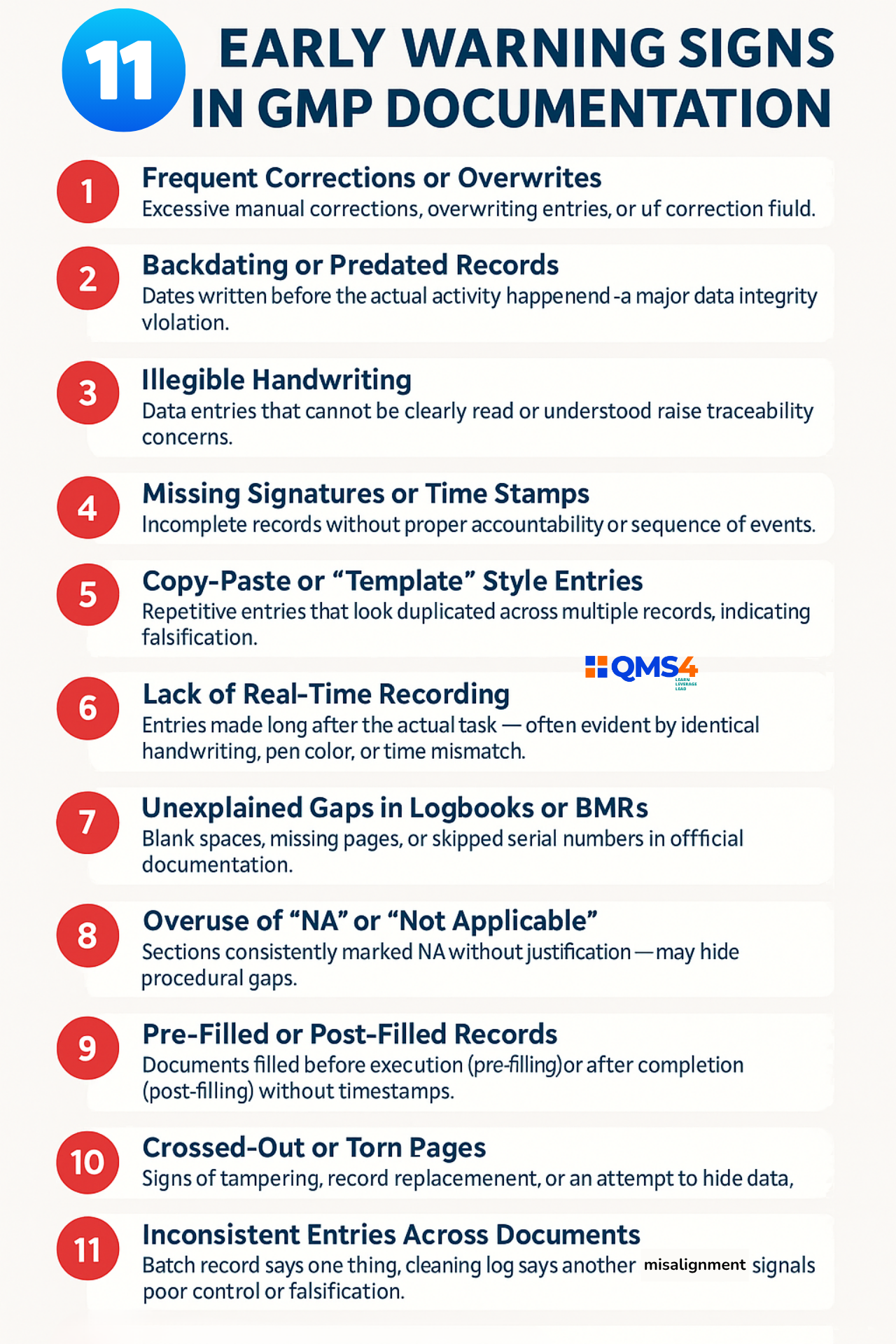
Here are the – 11 Early Warning Signs in GMP Environments.

Eleven early warning signs of SOP non-compliance in pharmaceutical manufacturing.
Early indicators that SOP compliance is slipping — before major deviations occur.

Read the full FDA 21 CFR Part 211 regulation here.


The Grey Zones That Invite SOP Shortcuts

Every facility has them — the “grey zones” where procedures aren’t crystal clear, or where the wording leaves room for interpretation.
These gaps in documentation create a breeding ground for “personal versions” of the SOP.

Example:
An SOP says, “Visually inspect the equipment for cleanliness before use.”
No one defines what “cleanliness” means, or documents the inspection step with photos or checklists.
So, each operator decides what’s “clean enough.”

From a QA perspective, this is a nightmare.
From an operator’s perspective, it’s just making a judgment call in the moment.

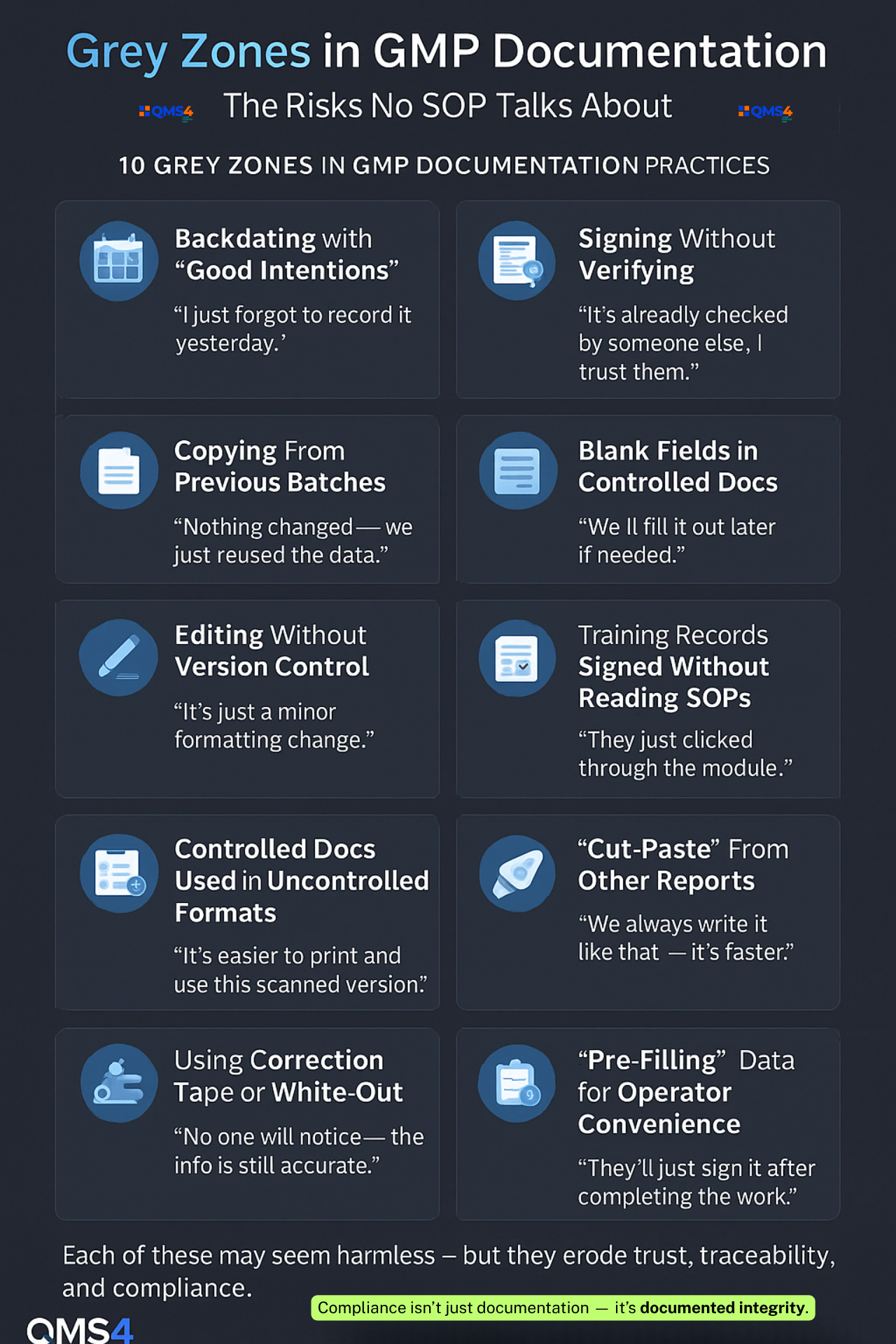
Here are the – 10 Grey Zones in GMP Documentation

Ten common grey areas in GMP documentation that lead to SOP shortcuts.
Where SOP language leaves room for risky interpretation.

Read the PIC/S Guide to GMP for detailed global quality requirements.


The SOP Compliance Struggles Nobody Talks About

In most GMP shops, there’s a silent tension:
Production feels pressured to meet output targets.
QA feels pressured to ensure compliance no matter the schedule.

This tension shows up as:

  • Frustration when QA rejects work.

  • Resistance to procedural changes.

  • Operators feeling QA “slows everything down.”

The truth is, SOP ownership is low when teams feel SOPs are designed for auditors instead of for the people doing the work.

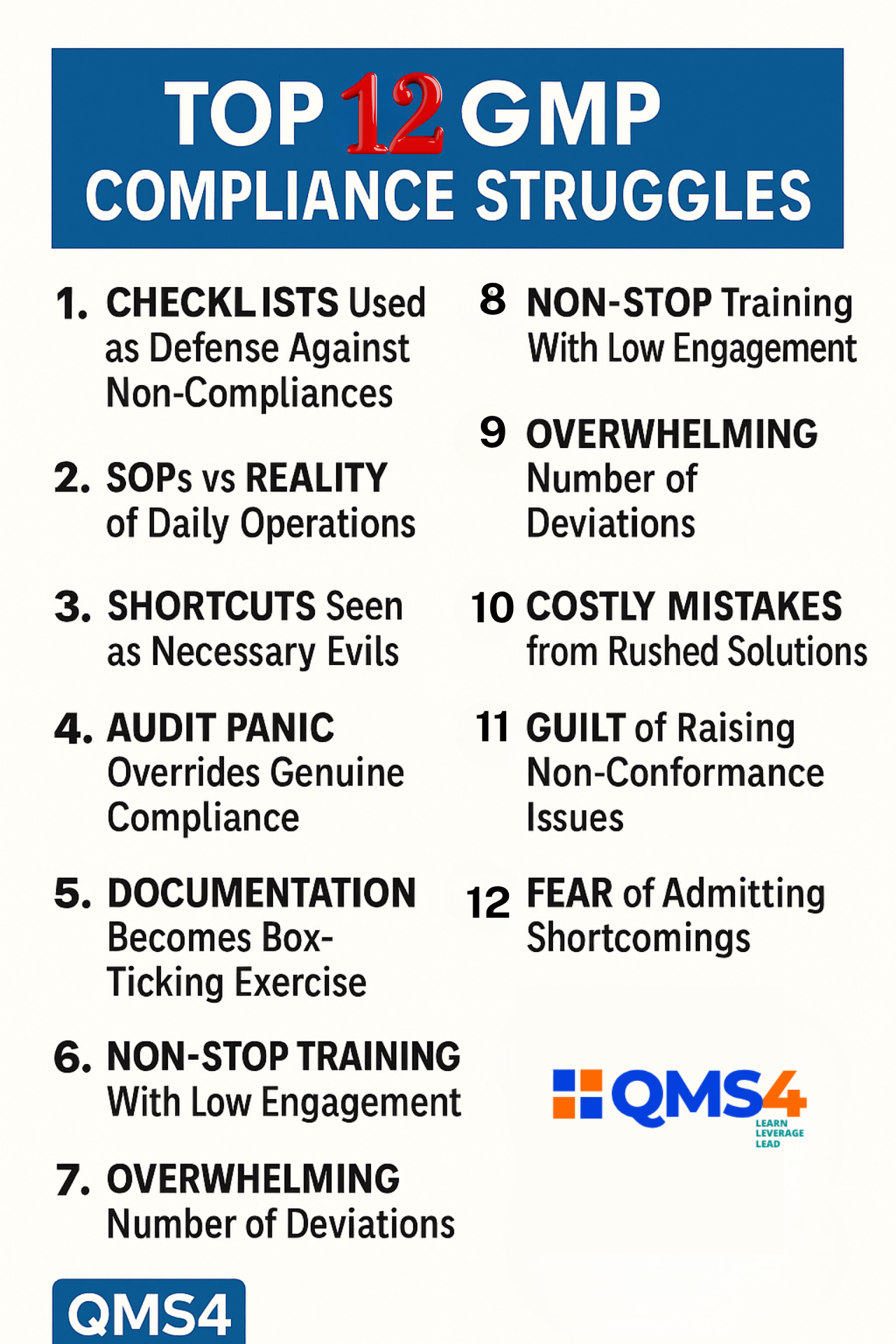
Twelve operational and cultural challenges that weaken GMP compliance.
The most common struggles teams face in sustaining GMP compliance.

Read the WHO GMP Guidelines to understand internationally recognized GMP standards.


Data Integrity — Where Small Slips in SOP Become Major Findings

Data integrity issues are rarely the result of malicious intent.
Most often, they start with small, pressured decisions:
“I’ll fill this in later.”
“This test result is obviously okay — I don’t need to double-check.”

Over time, these shortcuts form habits, and habits leave trails in your audit logs.

Whether it’s missing signatures, out-of-order entries, or undocumented corrections — each one can trigger a regulatory citation.

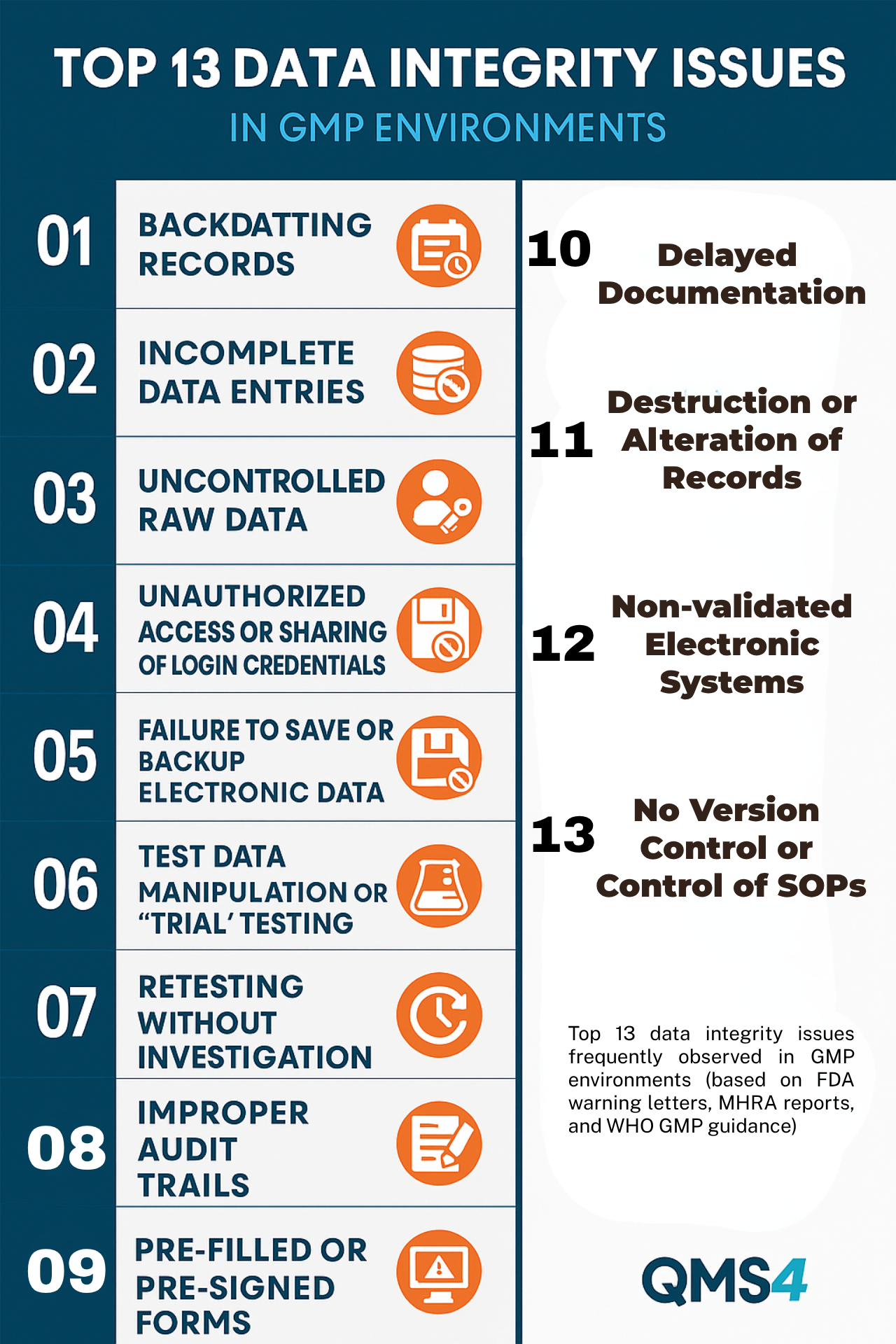
Here are : Top 13 Data Integrity Issues

Thirteen most common data integrity problems in GMP-regulated industries.
The most frequent audit findings related to data integrity.

Read the MHRA GxP Data Integrity Guidance for UK regulatory expectations.


How to Increase SOP Ownership Across Your Teams

Improving SOP compliance isn’t just about retraining.
It’s about changing how people perceive and value the SOP itself.

Some practical approaches:

  • Involve operators in SOP drafting.

  • Use visual SOPs where possible.

  • Align KPIs so compliance is rewarded alongside productivity.

  • Encourage feedback loops for SOP improvements.

  • Make SOPs easy to navigate on the shop floor.

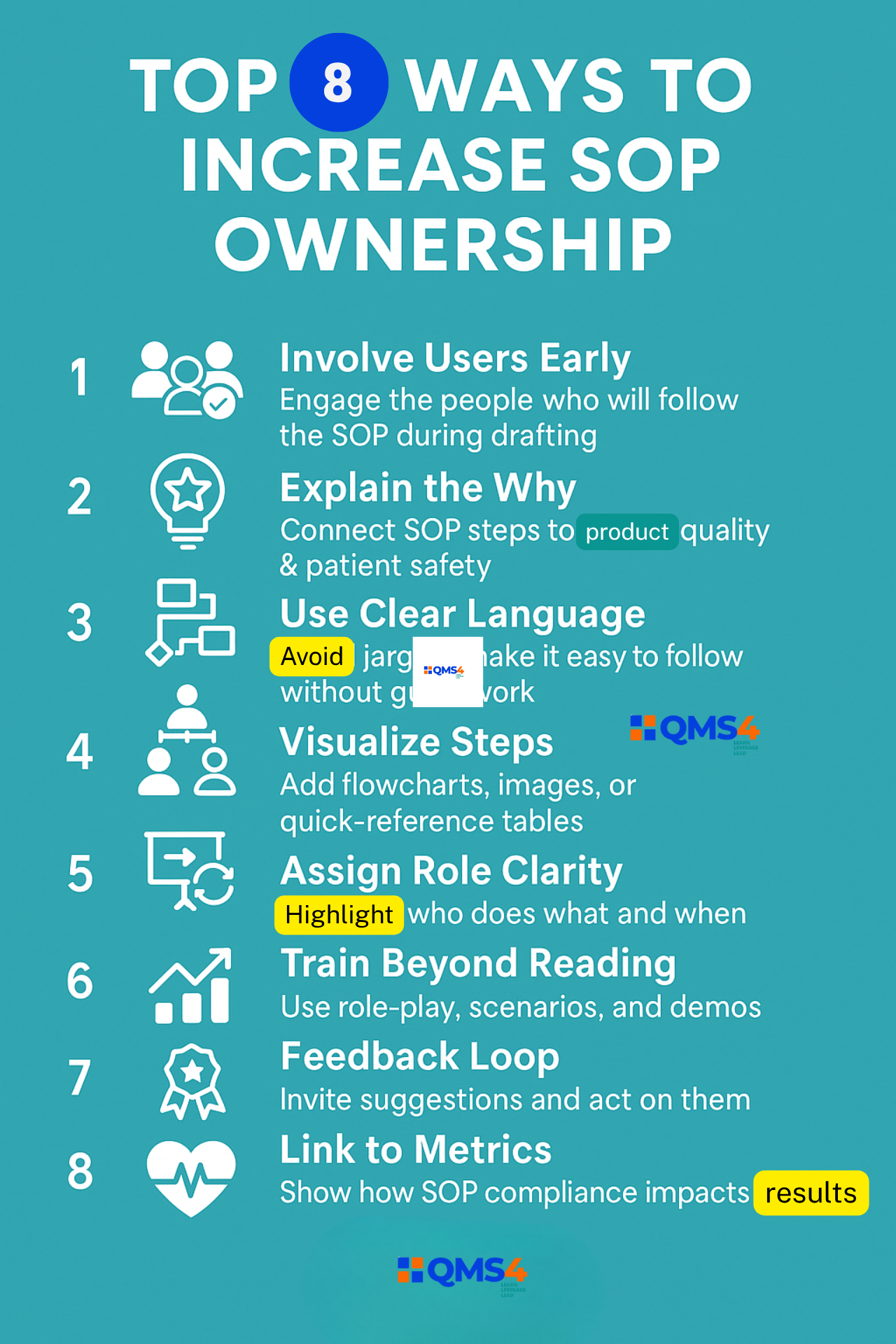
Here are: Top 8 Ways to Increase SOP Ownership

Eight practical strategies to improve SOP ownership across GMP teams.
Boost engagement and compliance with these proven SOP ownership tactics.

Read the ICH Q10 Pharmaceutical Quality System guideline for a structured approach to GMP compliance.


Reflective Takeaway

GMP isn’t just about doing things right.
It’s about building systems where people want to do things right — because they see the value, not just the rule.

When SOP ownership is high, audits stop being fear-driven events.
They become proof points of a healthy quality culture.


FAQs – SOP Compliance

  1. Why do people often skip following SOPs in GMP environments?
    Many employees face time pressure, unclear instructions, or lack motivation, causing them to bypass SOP steps despite knowing their importance.

  2. Is skipping SOPs always due to human error?
    Not necessarily. Often, it reflects systemic issues like poorly designed procedures, inadequate training, or a culture that discourages reporting deviations.

  3. How can quality leaders reduce SOP non-compliance?
    Leaders can model good behavior, foster open communication, and involve teams in creating realistic, user-friendly SOPs.

  4. What role does workplace culture play in SOP adherence?
    A positive culture where employees feel safe to speak up encourages consistent SOP compliance and reduces hidden deviations.

  5. How does burnout impact SOP compliance?
    Burnout reduces focus and motivation, making employees more prone to take shortcuts or overlook critical steps.

  6. Can behavioral CAPA improve SOP adherence?
    Yes, by addressing root causes beyond retraining, such as mindset, environment, and leadership support, behavioral CAPA leads to sustainable improvements.

  7. What practical steps can teams take to make SOPs more followable?
    Using visual aids, simplifying language, piloting SOPs with operators, and soliciting regular feedback helps make SOPs easier to follow.

  8. How does audit readiness relate to SOP compliance?
    Consistent SOP adherence minimizes deviations and findings during audits, ensuring smoother inspections and regulatory trust.


Want more insights like this?

Connect with me on LinkedIn for – “Quality Career & GMP Insights”.

Follow QMS4 | Connect with Lokman | Subscribe to Newsletter (Quality Career and GMP Insights)

👇 Drop a comment, share your experience or DM me — your voice matters. It might help another quality professional break free from burnout. And honestly, it inspires me to keep writing….

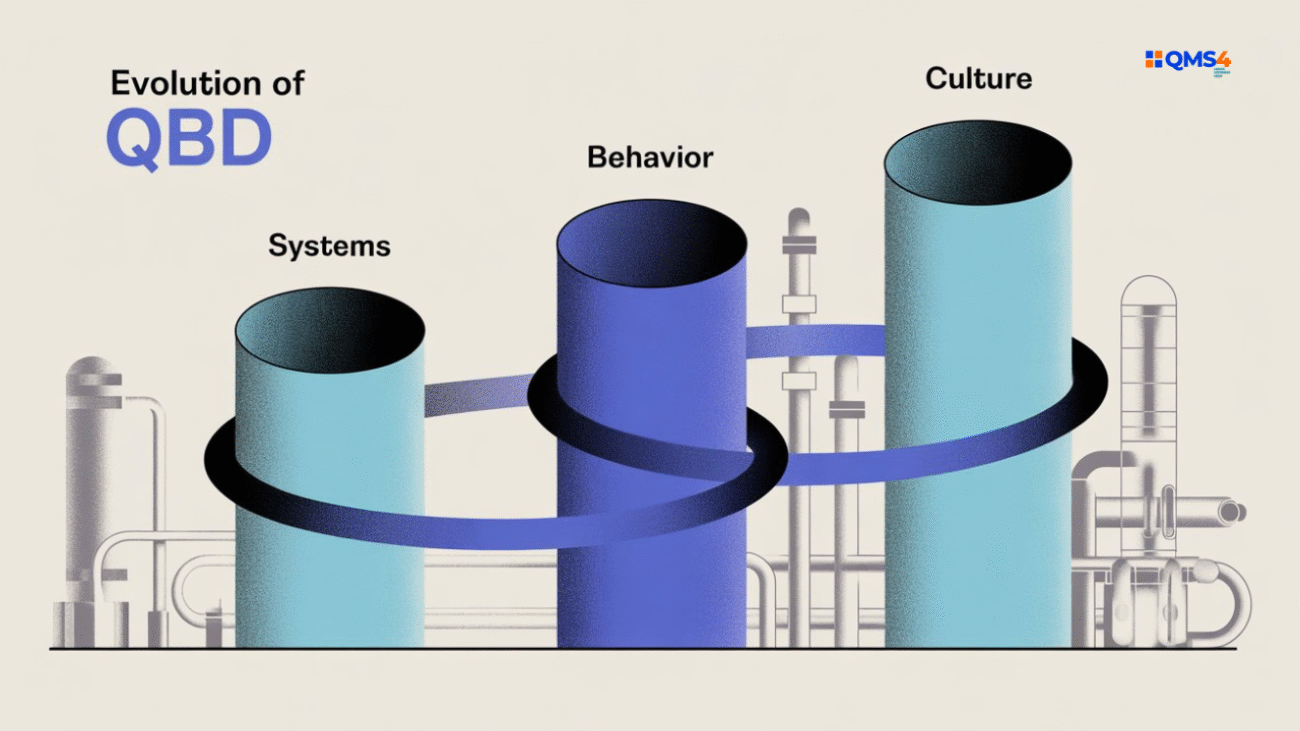
Visual of QbD evolution with pillars representing systems, behavior, and culture in pharma

The QMS4 Lens on QbD: A Modern Redesign Rooted in Human Systems

Introduction: QbD Is Aging — But Not Gracefully

When the pharmaceutical world embraced Quality by Design (QbD) in the early 2000s, it was revolutionary. The idea that quality could be built into a product rather than tested at the end was a massive shift from reactive quality assurance to proactive quality design. ICH Q8 (R2), Q9, and Q10 formed the Holy Trinity of this movement.

But here’s the hard truth: QbD hasn’t fully delivered.

Not because the principles are flawed, but because the application stopped short. We’ve built incredible design spaces, control strategies, and risk assessments. But we never designed for the behavioral systems behind them. The assumption was: “If you design the process well enough, the people will follow.”

That assumption is cracking.

At QMS4, we believe it’s time for QbD 2.0—a model where People, Patterns, and Culture are given as much design attention as Products and Processes.

This article explores that redesign.


The Gap in Traditional QbD

ICH Q8 tells us how to define design space and control variability. Q9 gives us a risk lens, and Q10 ties it into the pharmaceutical quality system.

But none of these guidelines teach us:

  • How to reduce human error without blaming people
  • How to create CAPAs that change behavior, not just fix systems
  • How to maintain quality when pressure, fatigue, and ambiguity rise
  • How to design quality habits, not just quality documents

The gap isn’t in the science. It’s in the behavioral systems that support that science.


Behavior Is a System

Let’s be clear: Behavior isn’t random.

Most quality failures don’t happen because someone didn’t know what to do. They happen because the system around them wasn’t designed to support the right action at the right time. Think:

  • CAPA fatigue
  • Checklist blindness
  • Risk normalization
  • SOP non-compliance (even after retraining)

These aren’t knowledge gaps. These are behavioral breakdowns.

And just like we use design space and risk analysis to shape product outcomes, we need behavioral design to shape quality outcomes.

The QMS4 Redesign: QbD Rooted in Human Systems

At QMS4, we propose a modern framework that places human systems at the center of QbD 2.0. Here’s how:

1. Redesigning Risk: The Emotional Layer

ICH Q9 focuses on probability, severity, and detectability. But it misses:

  • Cognitive biases (e.g., optimism bias, anchoring)
  • Emotional trade-offs (e.g., speed vs. safety)
  • Perception of risk vs. actual risk

In the real world, people don’t assess risk like a spreadsheet. They use heuristics, habits, and social cues. So we redesign risk tools to include behavioral triggers and motivational context.

Example: In supplier audits, we train assessors to detect “compliance theater” — when systems look compliant but behavior says otherwise.

2. From SOPs to Habits: Procedural Literacy

Most SOPs are long, abstract, and cognitively dense.

QMS4 think the idea of Procedural Literacy — designing SOPs that:

  • Are intuitive, not just compliant
  • Use visuals, nudges, and reminders
  • Acknowledge friction points (e.g., time pressure, shift handover)

We treat SOPs as behavioral artifacts — not just documents, but tools to influence consistent action.

3. CAPAs That Change Behavior, Not Just Systems

The typical CAPA cycle is:

  1. Identify root cause
  2. Fix the system
  3. Retrain people

But retraining doesn’t work if the system still supports the wrong behavior.

We propose to apply behavioral science in CAPA design:

  • Use of behavioral mapping (5 Whys + Emotional Whys)
  • Design interventions with feedback loops
  • Include behavioral KPIs (e.g., adherence, engagement, peer feedback)

We move from Corrective Action to Cognitive Alignment.

4. Patterns Over Incidents

Traditional QbD reacts to events.

QbD 2.0 think to tracks patterns.

Example: Instead of treating each deviation as an isolated case, analyze:

  • Time of day
  • Task complexity
  • Psychological state (fatigue, stress)
  • Team dynamics

This creates a behavioral risk profile for each process, line, or shift.

Patterns predict future failure better than any single root cause.

5. Metrics That Matter

What gets measured gets managed. But what if we’re measuring the wrong things?

QMS4 proposes a shift from only measuring output (e.g., number of deviations) to measuring:

  • Signal strength (are people reporting early?)
  • Psychological safety (are issues raised without fear?)
  • Habit strength (how automatic are quality actions?)

We use tools like behavioral pulse surveys, incident lag analysis, and quality culture heatmaps.

6. Culture: The Invisible Design Space

Culture is often treated as “soft” or secondary.

But at QMS4, we think, culture is the design space of behavior. It influences every quality decision:

  • Do people speak up?
  • Do they challenge a bad batch?
  • Do they prioritize patient safety over production targets?

QMS4 proposing to use models like Schein’s Cultural Iceberg and The 5C Culture Framework to integrate culture into QbD 2.0.


Where the ICH Guidelines Fall Short

Let’s briefly revisit the ICH trilogy:

ICH Q8: Pharmaceutical Development

  • Focus: Design Space, CPPs, CQAs
  • Gap: No guidance on behavioral variability, decision-making in ambiguity

ICH Q9: Quality Risk Management

  • Focus: FMEA, Fault Tree, Risk Matrices
  • Gap: No mention of cognitive bias, motivational trade-offs, or organizational behavior

ICH Q10: Pharmaceutical Quality System

  • Focus: Lifecycle approach, Management Review
  • Gap: No structure for measuring behavior, cultural maturity, or leadership influence

The QMS4 doesn’t discard these—it extends them.


Let’s think of a scenerio: The Aseptic Fatigue Failure

Company X had invested heavily in design controls. Their procedures were top-tier. But over a 6-month span, they had repeated gowning violations and near misses.

A typical CAPA suggested retraining.

Consultant Y was brought in and discovered:

  • Shift overlaps led to shortcuts during gowning
  • Visual cues in the change room were inconsistent
  • Peer pressure discouraged reporting “small stuff”

Consultant intervention:

  • Redesigned gowning room with behavioral cues (for example “Right Vs Wrong Displays”)
  • Created peer recognition for best practices
  • Introduced micro-feedback loops (badge system)

Result:

  • 68% reduction in deviations in 3 months
  • Higher reporting of minor issues
  • Increased team ownership of in behavior

Pharma vs Food: Two QbDs, One Missed Link

QMS4 works across food, pharma, and biotech. And here’s what we found:

  • Food QbD focuses more on process control and hazard prevention
  • Pharma QbD is heavier on documentation and risk modeling

But neither designs for people.

Whether it’s cross-contamination in a dairy plant or line clearance in a sterile facility, behavior is always the tipping point.


QbD 2.0: A New Definition

“Quality by Design is a systematic approach to development that begins with predefined objectives and emphasizes product and process understanding and control, based on sound science and quality risk management.” — ICH Q8 (R2)

QMS4 redefines it:

“QbD 2.0 is a human-centered approach to quality that integrates process, behavioral, and cultural design in addition to product to deliver resilient, compliant, and high-performing systems.”

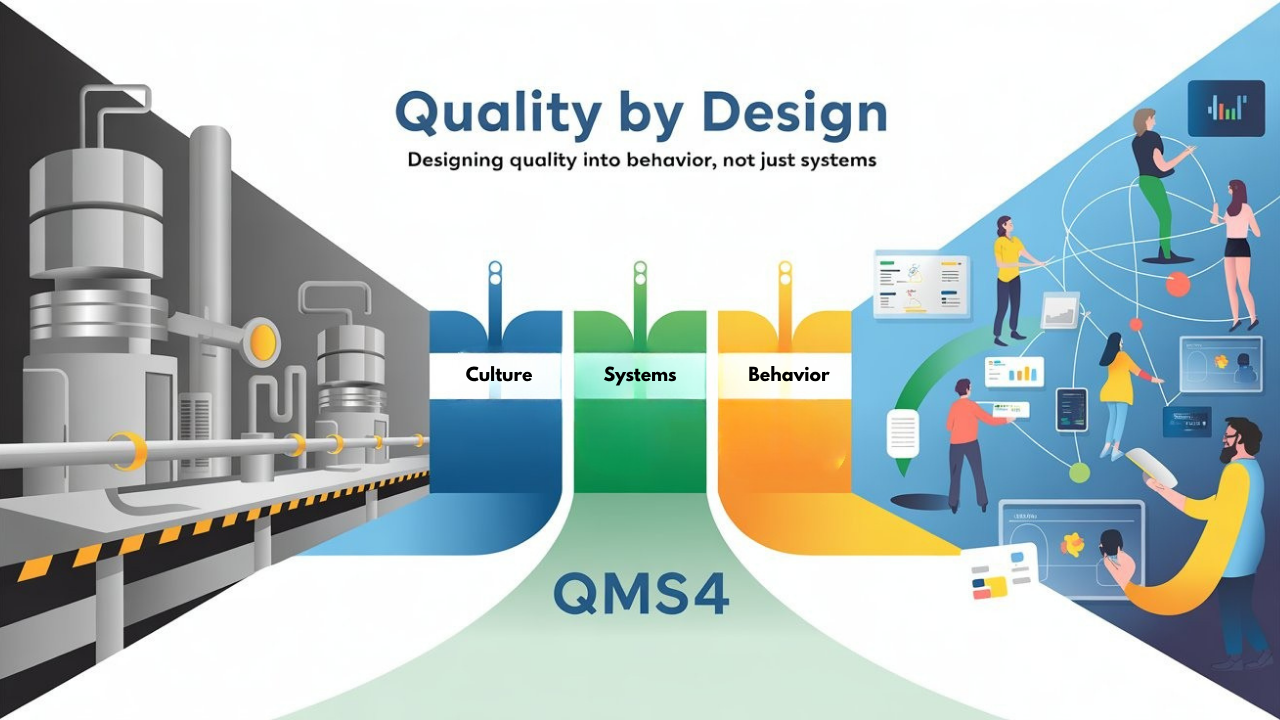
llustration of three interconnected pillars labeled Systems, Behavior, and Culture in a pharmaceutical facility, with 'Behavior' highlighted in teal to represent the QbD 2.0 shift toward behavior-centric quality.
QbD 2.0: From Process to People — Behavior, Culture as the Missing Pillar.

Conclusion: Design for the People Who Power the Process

Systems don’t fail. Behaviors do.

If we want resilient GMP systems, audit-ready documentation, and a culture of quality, we need to stop designing only for the molecule or the machine.

We must design for:

  • The operator under pressure
  • The supervisor managing trade-offs
  • The QA lead juggling compliance and coaching

That’s the QMS4 lens on QbD.

Let’s evolve.

Let’s redesign.

Let’s humanize quality.


Want more insights like this?

Connect with me on LinkedIn for – “Quality Career & GMP Insights”.

Follow QMS4 | Connect with Lokman | Subscribe to Newsletter (Quality Career and GMP Insights) |

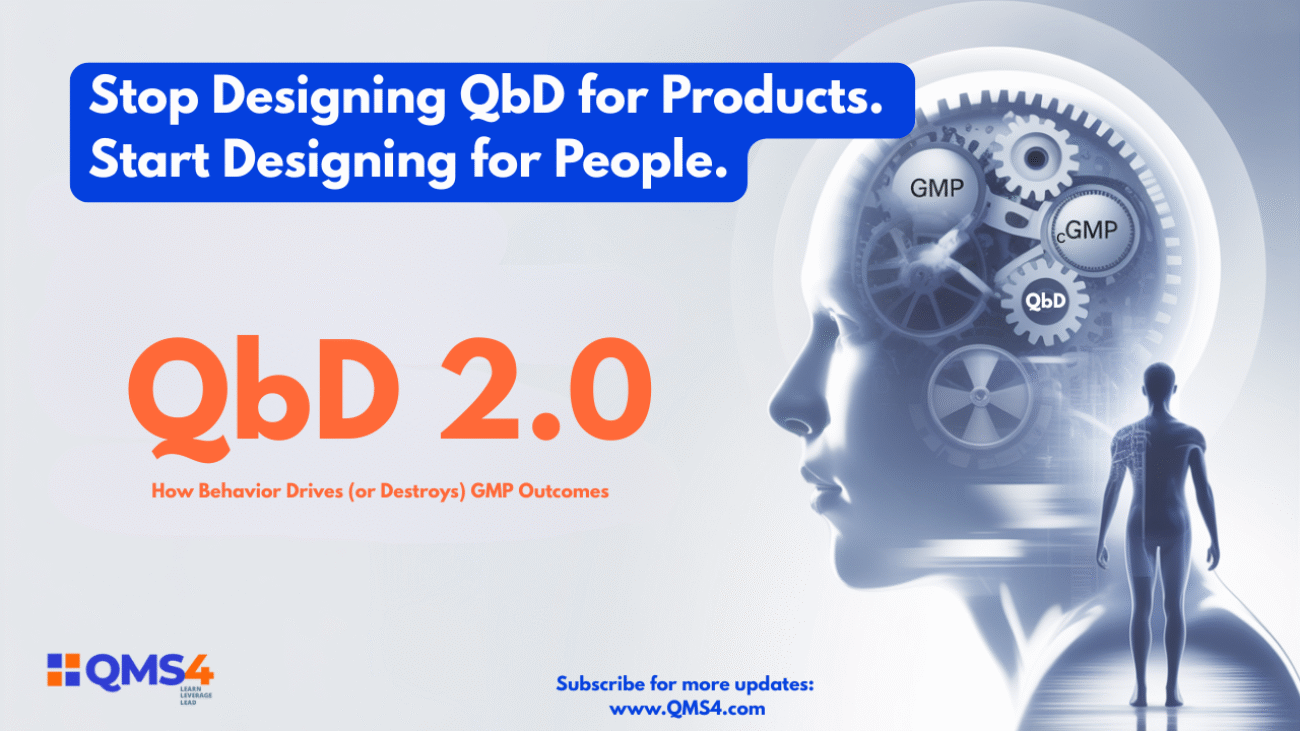
Illustration showing the human side of Quality by Design in pharma – representing behavioral systems, GMP culture, and process design

QbD 2.0 in Pharma: Designing Quality into People, Not Just Products

Let’s start with a hard truth.

If Quality by Design (QbD) was meant to revolutionize pharma quality systems, why do we still spend 18 to 24 months preparing for a 3-day inspection? Why does the fear of a 483 still loom like a dark cloud over audit readiness?

Why do major findings still show up — even after all the procedures, protocols, validations, and controls are in place?

And here’s one that stings:

“We wrote 40 SOPs in three weeks — just for the audit. Not for GMP compliance. Not for sustained quality.”

Sound familiar?

If you’ve ever seen 30, 40, or even 50 SOPs signed on the same date, you’ve probably asked:

“When did they train people on all this?”

Most SOPs aren’t written to help people do the job better — they’re written to pass audits.

What’s Really Broken in Pharma QMS?

Let’s go deeper:

  • Change control feels like bureaucracy, not improvement
  • QMS software slows users down instead of supporting them
  • Internal audit reports get filtered to avoid political tension
  • We settle for symptoms instead of root causes — because closure, not learning, is the priority
  • Deviation classifications get manipulated to avoid escalation

If you’ve been in quality long enough, none of this surprises you.
And yet — we rarely say it out loud.

Why This Article Matters

In quality, we’ve spent decades perfecting how to design quality into products. Traditional QbD was a breakthrough — it taught us to build quality into the process from the beginning, not inspect it at the end.

But after 20 years in the field — 17 of those inside global multinational companies — I’ve come to a humbling realization:

“We can design the perfect process on paper. But if people don’t think, act, or decide with quality in mind — it doesn’t matter.”

That’s where traditional QbD falls short.

So here’s the uncomfortable question:
What if QbD has a blind spot?
A blind spot so critical that it explains why even mature systems still buckle under pressure?

QbD, in its traditional form, focuses on product specs, process controls, and risk assessments.

But it misses something fundamental:

  • How people behave under pressure
  • How decisions are made in grey zones
  • How culture shapes shortcuts, workarounds, and silence

In short: QbD designs quality into processes — not people.

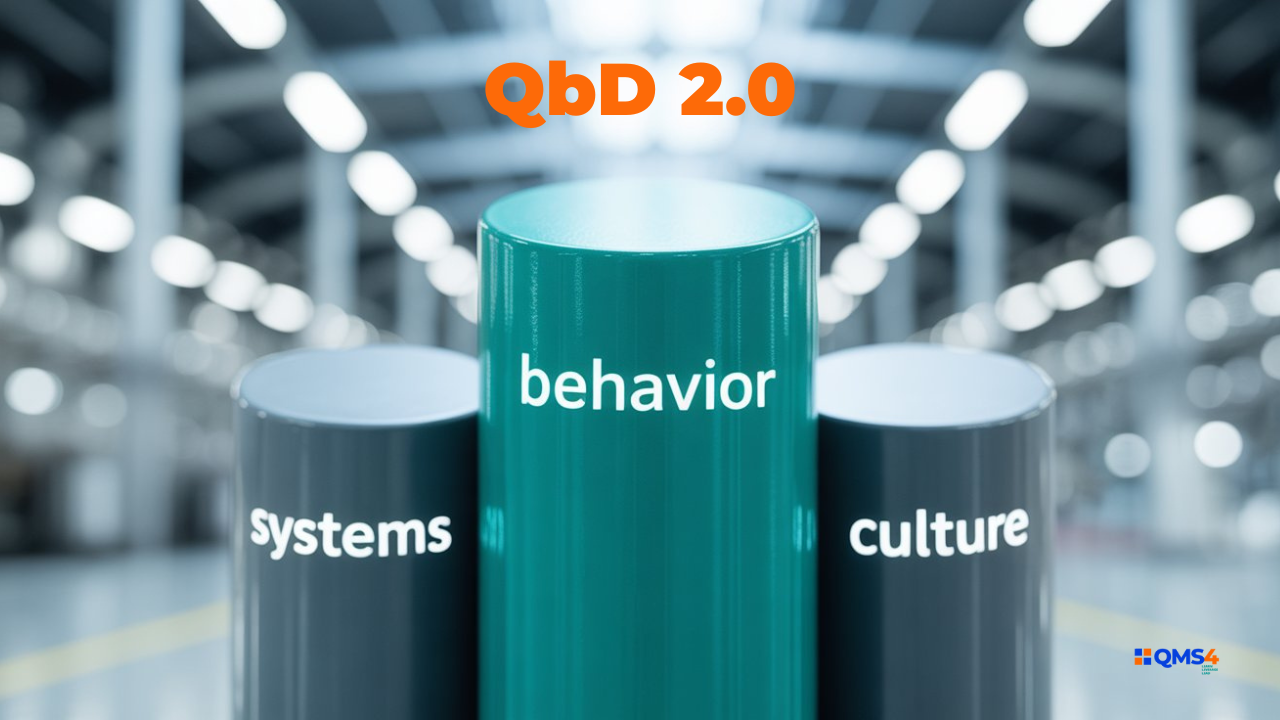
A visual representation of Quality by Design 2.0 with three pillars labeled Culture, Systems, and Behavior, emphasizing a holistic quality approach beyond technical processes.
QbD 2.0 stands on three pillars: Systems, Behavior, and Culture — because quality doesn’t end at the SOP.

When the Audit Alarm Bell Rings

It was 6:47 a.m. on a rainy Thursday when Rina, the QA Officer, got the message:

“Regulatory audit scheduled next week. Full scope. Be ready.”

Her stomach dropped.

The site had just wrapped a painful CAPA cycle.
The training tracker showed multiple overdue records.
The new QMS software still glitched on uploads.
And there were whispers — always whispers — of skipped verifications on night shifts.

Rina took a deep breath. Not because she didn’t know what to do.
But because she did.

  • Fourteen-hour shifts
  • “Urgent” document updates
  • Backdated training
  • Compliance firefighting
  • People walking on eggshells

“We design quality into the product,” her manager would say.
But no one talked about the decisions made at 2 a.m. under pressure.
No one talked about designing quality into behavior — not just documents.

Why Good People Still Miss Things

This article is for every professional who has asked:

  • Why do experienced, well-intentioned people still make mistakes in GMP settings?
  • Why does compliance feel reactive instead of built-in?
  • Why does traditional QbD stop at the product?

Let’s consider a typical deviation:

A critical step was missed during line clearance.

The investigation follows protocol:
Deviation logged. Fishbone diagram. 5 Whys. RCA template. CAPA logged and closed.

But we know the deeper story:

  • The operator skipped the step because the batch record was confusing
  • The line lead didn’t double-check because they were short-staffed
  • The engineer didn’t escalate to avoid tension
  • The supervisor gave verbal approval — “just this once”

Each of these actions is behavioral — not procedural.

Traditional QbD assumes that if systems are right, people will follow.
But people don’t always work that way.

Real Life Example: The QA Officer Who “Failed” for Doing the Right Thing

Let’s think of a scenerios, Olivia — a new QA officer — flagged a critical cleaning validation gap.

She was correct. She was committed.
But her feedback caused a batch delay.

The production head was annoyed.
The site director questioned her timing.
Her manager advised her to be more “practical.”
Three months later, her contract wasn’t renewed.

What message does that send?

You can design the SOP.
You can design the policy.
But if you don’t design for accountability, courage, and trust, the system punishes good decisions.

The Psychology of Quality: Systems, Nudges, and Biases

People don’t always make decisions based on logic.
We’re influenced by emotion, context, memory, fatigue, and social cues.

Even when QbD systems are technically sound, quality outcomes can be undermined by predictable human behavior:

 Checklist Blindness

  • Fields marked “critical” become background noise
  • Red flags get ignored if they’ve never caused issues
  • People stop “seeing” what they see every day

How to fix it:

  • Reduce checklist fields by 20%
  • Use icons and color cues
  • Rotate formats periodically

 CAPA Fatigue

  • Multiple deviations = one generic “training” CAPA
  • Root causes repeat: “human error,” “lack of attention”
  • Closure becomes a checkbox, not a change

Truth: Human error is a symptom — not a cause.
If the system doesn’t change, neither will the outcome.

 Cognitive Bias in Risk Assessments

  • We assume others understand what we understand
  • Familiarity lowers our risk perception
  • We over-trust procedural compliance

These aren’t process flaws. They’re human perception gaps.

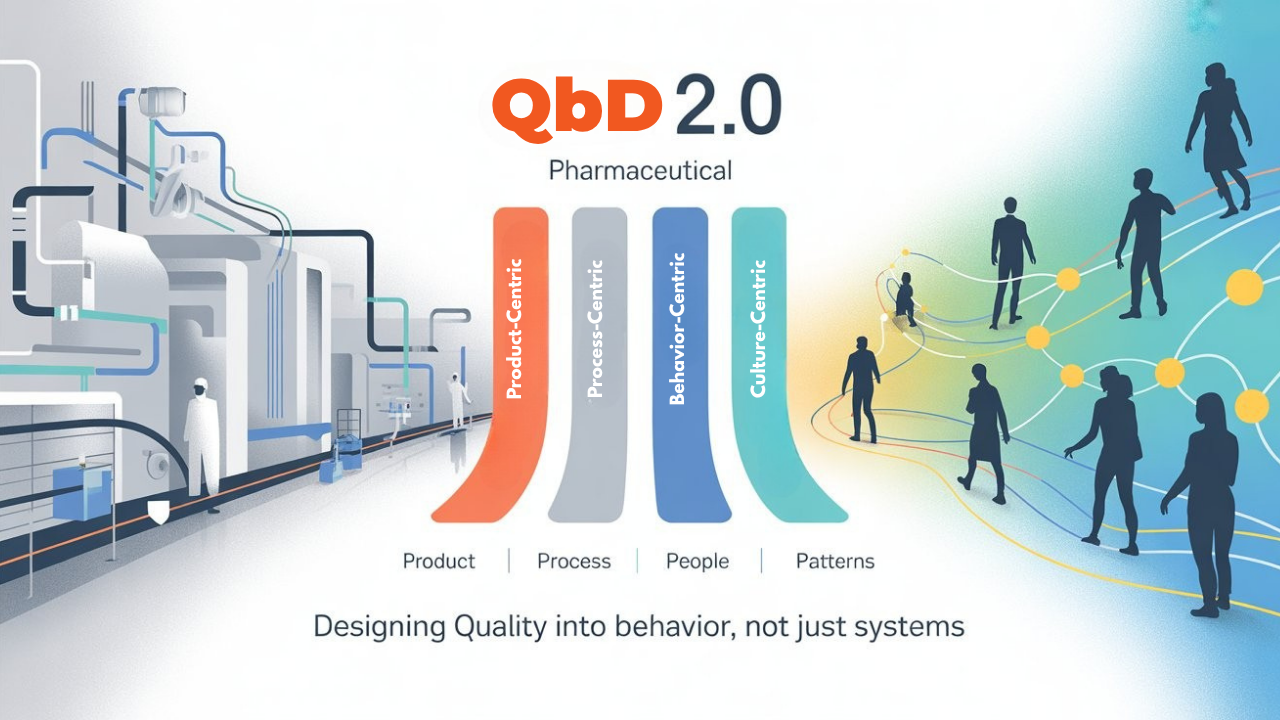
QbD 2.0 = Product + Process + People + Patterns

To evolve QbD, we must design not just for systems, but for behavior.

Here’s what QbD 2.0 looks like:

 1. Product

Traditional: Define Critical Quality Attributes (CQAs)
QbD 2.0: Also define user risk behaviors (e.g., misuse, storage errors)

 2. Process

Traditional: Control CPPs, ensure process capability
QbD 2.0: Also build behavioral friction (e.g., smart deviations, forcing functions)

 3. People

Traditional: Train staff on SOPs
QbD 2.0: Also design culture cues (e.g., feedback loops, peer norms, psychological safety to speak)

 4. Patterns

Traditional: Analyze audits, metrics, deviations
QbD 2.0: Also map behavioral drift over time (e.g., CAPA fatigue, normalization of shortcuts)

A diagram showing the four pillars of QbD 2.0 — Product, Process, People, and Patterns — representing a modern, holistic approach to pharmaceutical quality.
QbD 2.0: Designing Quality across Products, Processes, People, and Patterns — not just the production line.

Where to Apply This Framework

Use QbD 2.0 principles in:

  • RCA investigations
  • Internal audits
  • SOP and checklist design
  • Onboarding programs
  • Continuous improvement cycles

Ask not just: “Did they follow the SOP?”
Ask:

  • “What made the wrong action easier?”
  • “What do we tolerate that reinforces poor decisions?”
  • “What makes the right choice harder than it should be?”

Design Quality into Decision Points — Not Just Deliverables

Every procedure is a decision environment.

  • Will the analyst document honestly — or quietly “correct” a mistake?
  • Will the technician stop when something feels off — or keep going?
  • Will the QA reviewer raise a flag — or avoid tension?

Don’t just define the right step.
Design the environment that makes it easier to take.

Behavioral Design in Action

 1. Smart Deviation Review

Add a field: “Was any workaround used, even if no deviation occurred?”

This normalizes discussion of behavioral gaps before they become audit findings.

 2. Reinforcement Messaging

Instead of annual training on ALCOA+, display monthly micro-reminders on screensavers, passcards, or checklists:

“Integrity = I do it the way I say I do it.”

Simple, frequent repetition works better than dense training slides.

 3. Pre-Mortem Before Process Changes

Before implementing a change, ask the team:

“What’s the most likely way this will be ignored or bypassed in 6 months?”

This activates real-world behavioral foresight — not just procedural theory.

Why This Matters: The Future of Quality Is Behavioral

By 2030, the most compliant sites won’t just have perfect documentation.
They’ll have:

  • Teams that trust and challenge
  • Cultures that reinforce integrity
  • Systems that nudge the right choice

They will:

  • Design SOPs that are usable, not just compliant
  • Write deviations that tell stories, not tick boxes
  • Create systems that help people want to do the right thing

This isn’t about being soft — it’s about being strategic.
Because systems don’t behave. People do.

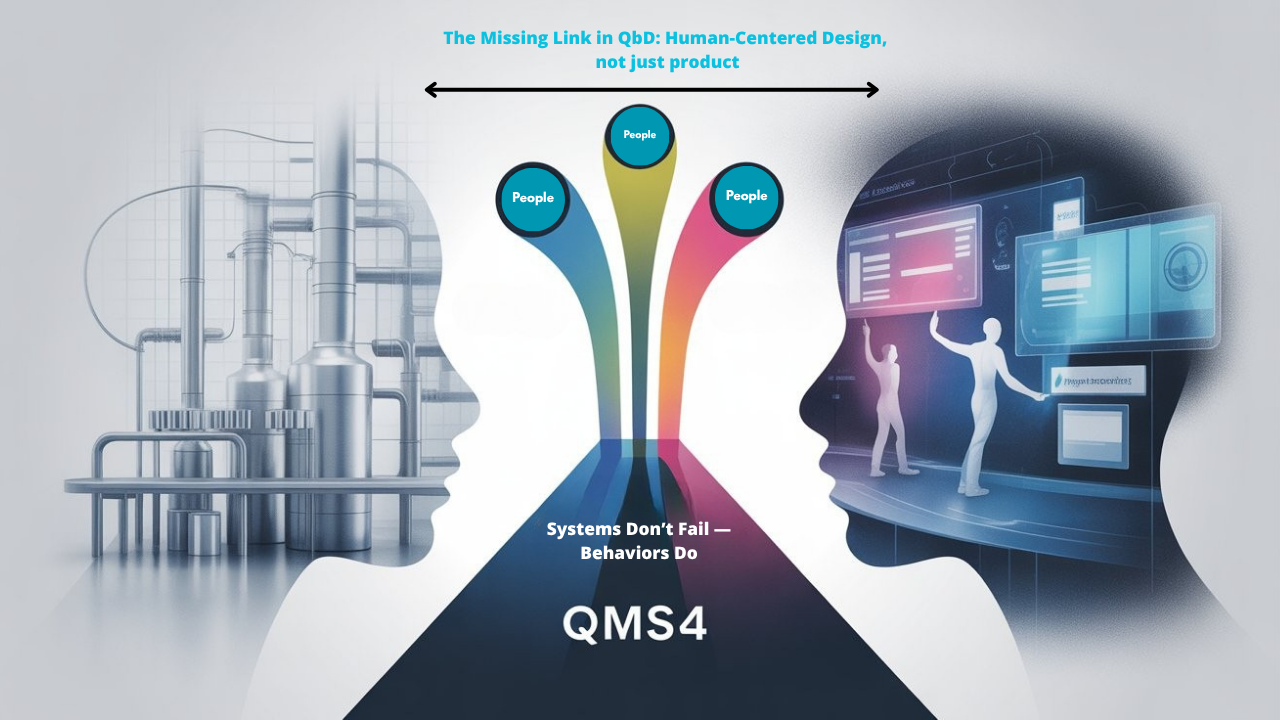
Three pillars labeled People, representing the behavioral foundation of QbD 2.0, with a central message: Systems don’t fail—behaviors do.
Systems don’t fail. Behaviors do. That’s why QbD 2.0 is built on one foundation: People.

Final Reflection: Quality is a Human System

Let’s go back to Olivia — the QA officer from the beginning.

What if her company didn’t just fix documents for the audit?
What if they fixed the behavioral gaps the system creates?

Imagine a workplace where:

  • Supervisors don’t fear escalation
  • Checklists are designed to engage
  • Human error is investigated, not punished
  • QbD includes behavior — not just specs and controls

“Every system is perfectly designed to get the results it gets.” — W. Edwards Deming

If we want better outcomes, we must build better systems — and that means better behavior by design.

Key Takeaways: What You Can Expect from QbD 2.0

Traditional QbD misses the behavioral dimension — people, perception, habits, and context
QbD 2.0 adds behavioral science, system psychology, and human-centered design
Start today: Design for decisions, not just for documentation

QbD 2.0 is not a new regulation. It’s a new lens.
A mindset that says: Quality isn’t just what we make — it’s how we think, act, and decide.

Let’s Reflect Together

Have you ever made a decision you weren’t fully sure about — because the system didn’t support another way?
How would your team change if QbD included behavioral design?

Share your thoughts. Let’s build better systems — not just fix broken ones.

Subscribe QMS4 for more real-world insights on quality, audits, and behavioral thinking in GMP.

Want more insights like this?
Connect with me on LinkedIn for weekly tips on GMP, audits, and quality careers.
 Subscribe to LinkedIn Newsletter (Quality Career and GMP Insights) |  Follow QMS4 |  Connect with Lokman